Kan Yasuda “Touchstone”
John McBride AM
My first encounter with the sculpture of Kan Yasuda was in Sydney in 2003, shortly after I returned to Australia following a career based in Tokyo. Leaving Tokyo left me disjointed and uncertain; I needed reassurance that moving back was the right decision, and I needed a reason to feel pride in my adopted city. I had lived through Tokyo’s best years — the edgy, globally admired fashion, architecture and art of the late 1970s and 1980s — and my corporate career had spanned the 1990s and 2000s, when the city was rediscovering itself through monumental art and architecture in a post-bubble world.
Sydney, by comparison, struck me as ugly. The city had lost so many of its handsome post-colonial sandstone buildings, replaced by poorly designed office blocks approved by a Sydney City Council later found to be corrupt in the late 1920s, the 1960s and the 1980s. Looking for a way in, I joined a series of guided tours run by a group of young architects. It was immediately clear they were proud of, and deeply knowledgeable about, Sydney’s streetscape and the policies the council had since adopted to encourage architectural and public-art excellence. If this article has one message, it is this: take a guided tour of your own city. Let art, architecture and history experts walk you through the place you live and use that knowledge to fall in love with it again.
I worked through every tour the group offered, and before long, through their eyes, I fell for the architecture and street art of my new home. The building at the centre of that story was Renzo Piano’s Aurora Place on Phillip Street, together with the major artwork standing outside it: Kan Yasuda’s “Touchstone” (2000), carved from solid Carrara marble. It’s almost too obvious to say the Sydney Opera House is the city’s — arguably the world’s — most beautiful building, and the tour had already given me a deep immersion in Utzon’s masterpiece by the time I was standing outside Aurora Place with a hand resting gently on Touchstone.
The quiet, reverential relationship between Aurora Place and the Opera House moved me. Here was Sydney’s newest and most beautiful structure, and beside it a sculpture by a Japanese artist worthy of standing there. The gentle curve of the Opera House’s sails, set against one of the world’s most beautiful harbours, was echoed both in the curve of Aurora Place’s glass facade and in the exquisite curves of Touchstone. At last, a new Sydney building that wasn’t just a cheap, square office block — one that could stand alongside Tokyo’s finest new architecture, of which I had been so proud.
Then there were the materials. Even to my untrained eye, the solid Carrara marble was obviously among the finest in the world. I later learned this quality of stone was precisely why Kan Yasuda had lived in Pietrasanta since 1974 — more than half a century spent building relationships with the quarry workers there, earning such deep respect that when an exceptional block was cut from the mountainside, the call would go out: “Respectfully, Maestro Yasuda, forgive us, but would you like to see the new stone?” The quality of the material is impossible to resist; I had to reach out and touch it. I now understand Yasuda welcomes exactly that response, at least at his public installations.
The Opera House roof is clad in over a million ceramic tiles, arranged in a chevron pattern, made in Sweden to exacting standards in two finishes — glossy white and matte cream — and engineered to be self-cleaning, always glistening against the harbour’s blue.
Jørn Utzon wanted the shells to read against the water rather than reflect it, so he avoided anything mirror-like. At Aurora Place, Piano used a similarly non-reflective material — orange, sandstone-toned terracotta — echoing the warm sandstone streetscape that once defined so much of the city and still survives in fragments. Piano, raised in Genoa in a family of builders, has a long attachment to terracotta and to craft materials generally. Above the terracotta base, the building’s white glass “sails” and fins — a fritted skin that tapers and folds at the top of each facade — deliberately gesture toward Utzon’s shells, just 800 metres away, which Piano treated as a defining contextual constraint on the design.
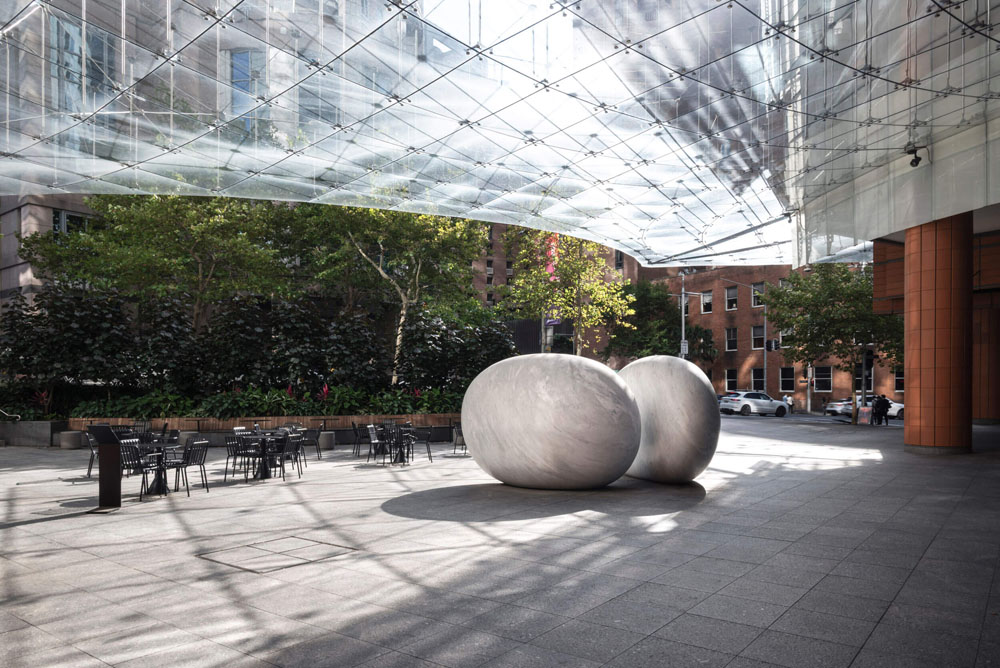
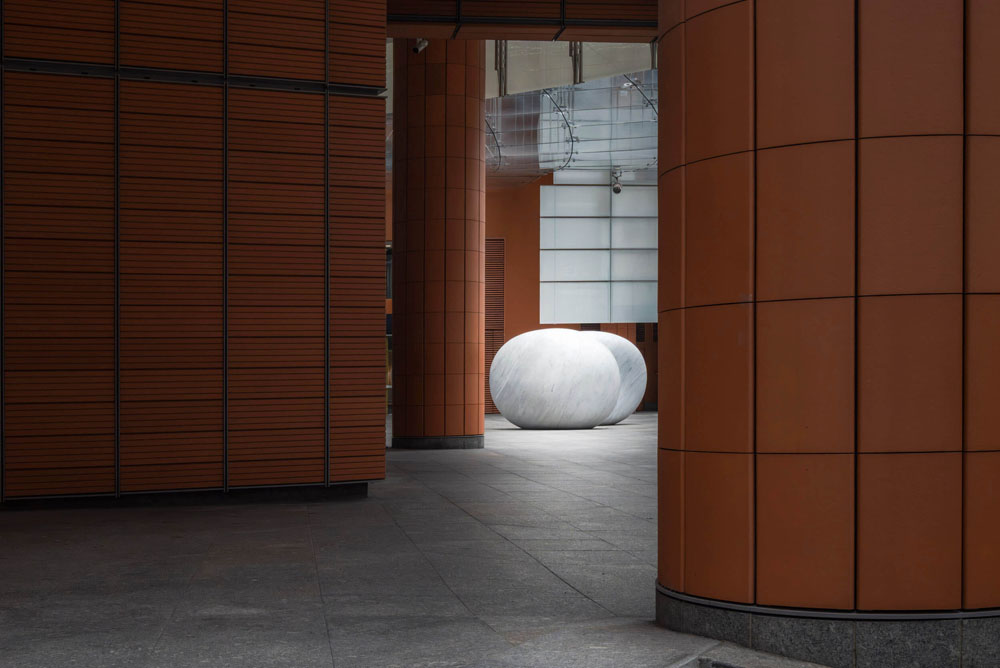
Touchstone Aurora Place, Sydney
By this point I had lost any doubt about my new city’s beauty. I was proud of Sydney because of two of the finest buildings anywhere, joined by a magnificent piece of public art from a Japanese artist connected to the country I loved. That alone would have been enough, but the tour went further, describing the relationship between Piano and Yasuda. Touchstone, they explained, was not an afterthought bolted on once the building was finished. Piano had long admired Yasuda’s devotion to Pietrasanta, a town to which he himself had deep ties through its stone-carving and architectural circles.
Piano has spoken warmly of Yasuda’s work more than once. In 2015 he wrote a welcome text for Yasuda’s “Touching the Time” exhibition in Pisa:
“I like his sculptures; they are often like giant pebbles dragged through the streets by the current of an unlikely flood. Smoothed by time and by the flowing water.”
It is hard to imagine a better description of Yasuda’s 2000 exhibition across Florence, when twelve monumental works occupied eight historic Renaissance sites throughout the city. As a further mark of respect, Florence installed three of his works permanently in the Boboli Gardens — the first modern sculptures ever admitted to that 500-year-old Renaissance collection. Thank you, Renzo Piano, for trusting Sydney with a relationship you clearly hold dear.
My pride in Touchstone deepened further once I learned how organically the collaboration had unfolded. Aurora Place’s own account puts it well:
“Artists are rarely brought in at the beginning of a project and rarely work directly with architects. But not so at Aurora Place. The developers encouraged the connection between architect and artist right from the commencement of the project, giving rise to an organic piece that sits harmoniously within its environment.”
That approach resonated with my own instincts about supporting artists.
My training in Japan was in tea ceremony — nearly forty years of serious practice in Kyoto, alongside an undergraduate thesis, written at a national university in Tokyo, on the great renaissance of the late Muromachi period centred on tea ceremony, Noh theatre and renga linked verse. Tea taught me how to build relationships with artists and support their work. The most extreme expression of this is found in the Head Houses of Tea and their centuries-long relationships with the ten great artisan households supplying the utensils that make the ceremony possible.
When I returned to Australia in 1983 for graduate study in Canberra, I met James Mollison, founding director of the Australian National Gallery. He became my mentor for the next thirty-seven years, until his death in 2020. James was one of the great builders of a national art collection, assembling Australia’s holdings of world art from nothing, and he taught me how to build relationships with artists and support their careers over the long term. I went on to collect the work of some 150 young Australian artists in depth — interviewing them annually, building genuine friendships, acquiring major works at each turning point in their careers, and gathering the supporting material behind each body of work, including preparatory sketches and maquettes. That collection has since been donated to the Art Gallery of Western Australia in Perth, where I was born, and to the British Museum’s Department of Prints and Drawings.
That, I think, is why I responded readily to the warmth between Yasuda and Piano, feeling it standing on a street corner at Sydney’s most prestigious address. Back in Tokyo, I had watched closely as Mitsui Fudosan developed Tokyo Midtown in Roppongi, uneasy about what would replace the site next to my own home, down a laneway beside the old Roppongi Self-Defence Force base. My house had been designed by the great Sakakura Junzō. It sat within an extraordinary enclave: Mrs Sakakura still lived downstairs, Arata Isozaki and his artist partner Aiko Miyawaki lived next door, Sakakura’s son ran his architecture practice at the front of the property, and Isozaki’s office stood down the side street. I was surrounded by architectural and artistic royalty, and fiercely protective of it. The Sakakuras kept a small gallery at the front of the house and held an opening most Friday evenings — often exhibitions of Le Corbusier’s sketches, since Sakakura had run Le Corbusier’s atelier for seven years.
Around the time I left Japan, the land beneath the old Defence Agency headquarters — originally the lower Edo-period residence of the Mōri clan, daimyo of the Hagi domain in what is now Yamaguchi Prefecture (my friends still tease me about this sort of trivia) — went up for sale. I was uneasy. I had spent my career in Tokyo unwinding by looking out my window at hundreds of mature trees dating back to that Edo-period residence. Ownership transferred to Mitsui Fudosan as I flew out, and construction began in May 2004. I was back on 30 March 2007 for Tokyo Midtown’s official opening, and my concerns eased almost immediately: some 140 trees from the old Defence Agency grounds had been carefully transplanted and preserved as Midtown’s greenery, and stones from the Mōri residence’s original drainage channels had been repurposed as retaining walls — a quiet, physical continuity with four centuries of the site’s closed history before it opened to the public.
Within this new setting, two works by Yasuda welcomed visitors. At street level stood the now-familiar “Myōmu,” in black bronze — sharing its title with, though distinct from, the white marble sculpture installed four years earlier in front of Sapporo Station. As in Sapporo, Tokyo’s citizens quickly adopted it: a meeting point before shopping or dining, a place for children to play while they waited, a small, quiet source of civic pride. I was even more struck, exploring Midtown on opening day, to find a second Yasuda work underground — 18.5 tonnes of white Carrara marble in the plaza beneath the connected Roppongi subway station. This was “Ishinki,” a title that would later lead me to a very different work of the same name on the shores of Lake Toya in Hokkaido.
These two sculptures set the tone for what large-scale urban development could be at its best: respectful of its environment and history, and genuinely additive to the quality of city life.
I now lead art tours to Japan for the Art Gallery of New South Wales, both directly, as study tours for the gallery, and through Renaissance Tours Sydney as part of its World Art Tours program. My admiration for Yasuda led me to plan a Hokkaido tour in 2018, to visit Lake Toya and Arte Piazza Bibai. As we prepared to board our flight to Sapporo, the Hokkaido Eastern Iburi Earthquake struck, on 6 September 2018. The Lake Toya area was hit hard again, which only deepened the significance, for me, of Yasuda’s moving lakeside installation, also titled “Ishinki.” That work had originally been installed to support the township of Toya after the 1977 eruption of Mount Usu, going up in 1987 and eventually giving rise to a sculpture park that now lines the lake’s shores. Standing before it, one feels strongly Yasuda’s humanity and his sense of communion with other people.
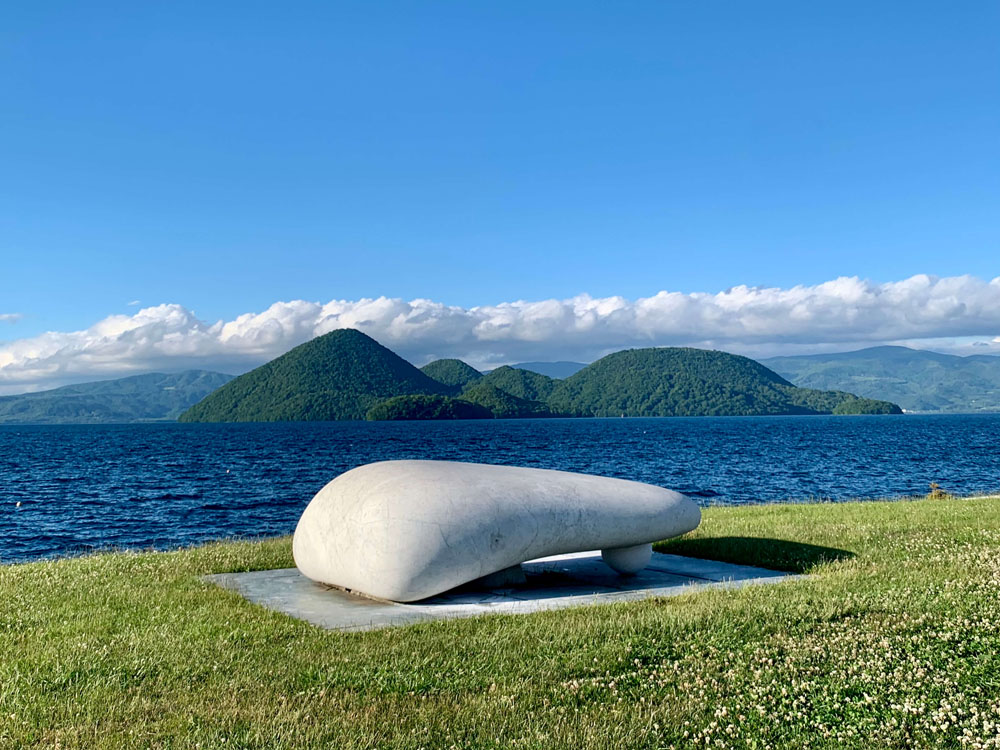
Ishinki Lake Toya, Hokkaido
That same quality is unmistakable at Arte Piazza Bibai, his monumental gift to his hometown, opened in 1992. A great deal has already been written in praise of Bibai. I finally led my long-delayed 2018 tour there for Renaissance Tours Sydney and the Art Gallery of New South Wales in 2025. Yasuda’s son guided our group of twenty-five art travellers expertly around the site, while Yasuda himself, teaching a sculpture class for local residents that day, joined us for lunch. My group fell instantly for his sculpture, and for the artist himself — it was the unquestioned highlight of the tour. Everyone delighted in talking with him, prying loose stories about his introduction to Sydney through the Touchstone project. One member of the group, initially too shy to approach him, held back until the very end. As we prepared to leave, she moved quietly to his side and spoke to him in her native Italian, telling him how deeply the visit had moved her, and how grateful she was to meet the creator of an art experience so humane and so connecting.
We left Bibai and Lake Toya lifted.
Proud of our own city, Sydney, and grateful for Yasuda’s lifelong devotion to his art.
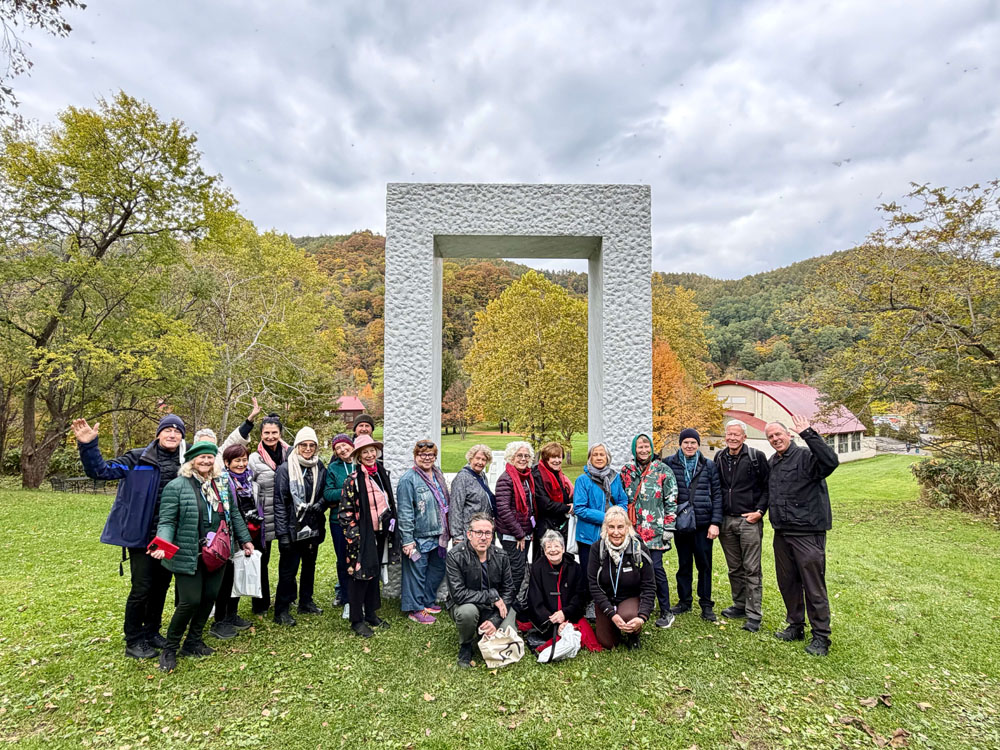
Art tour to Japan by the Art Gallery of New South Wales
Read John McBride AM’s essay on Arte Piazza Bibai here.
John McBride AM
2026